Scorpio News
The Mariner Project: Making Hydrogen Propulsion a Reality
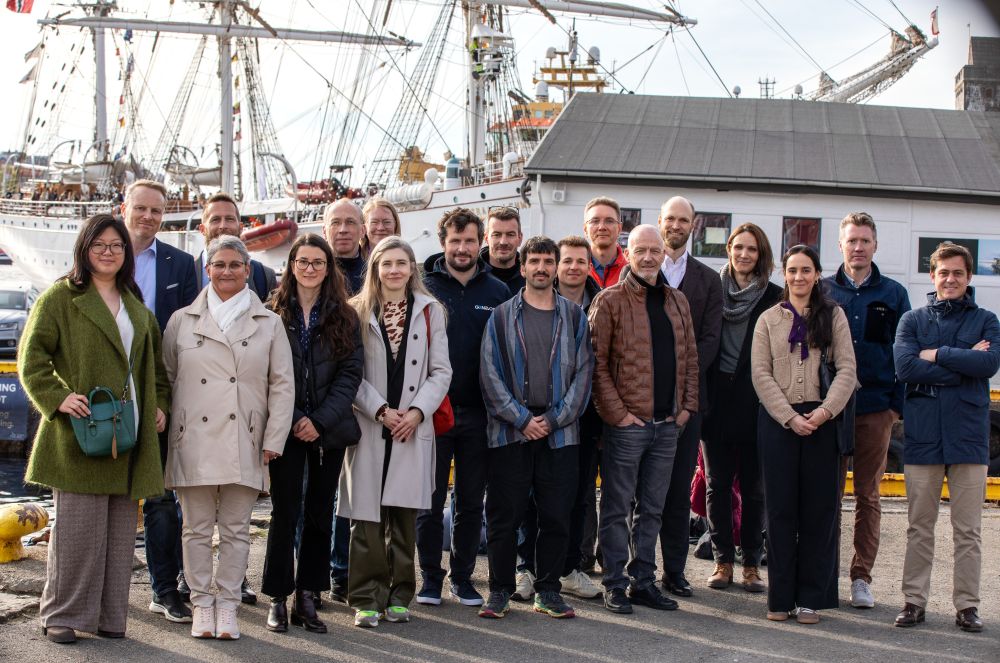
This past week, Scorpio joined a team industry leaders and researchers from around Europe in Bergen, Norway for the kick-off of the Mariner Project, a groundbreaking partnership in the development of a new generation of Hydrogen fuel cell technology. The goal, over the next 4 years, is to develop a 1 MW fuel cell system that can be built in modules, making it suitable for a wide range of vessels, from small ships to large ocean-going vessels.
The shipping industry carries around 90% of the world’s trade and accounts for roughly 3% of global greenhouse gas emissions. Despite incredible advancements in alternative fuel systems across several industries, maritime transport still relies almost entirely on fossil fuels. Without significant action, maritime emissions will increase by 2050 rather than trending to zero as per th net zero framework under discussion at the IMO. Additionally, recent geopolitical tensions have highlighted the world’s need for more resilient, locally produced energy solutions.
Scorpio has always been at the forefront of research and development for cleaner, more environmentally sustainable shipping. From redesigning our ships for more safety and efficiency, to running pilot programmes on carbon capture systems, to investing in the development of zero-emission propulsion systems, Scorpio, a founding member of the Monaco Hydrogen Alliance, is ahead of the curve on what works, what doesn’t, and what has great promise. Through the Mariner Project, we continue to support the push towards sustainable shipping.
Co-funded by the European Union through the Clean Hydrogen Partnership, the Mariner Project’s goal is to develop, validate and demonstrate a modular 1 MW Proton-Exchange Membrane (PEM) fuel cell system, scalable to ≥ 10 MW. The system is designed to meet strict maritime requirements in terms of performance, durability, safety, certification and cost; all of which have been key barriers to large-scale adoption.
To accomplish this, the Mariner Project fosters collaboration between leaders from across the value chain, from component developers to ship integrators and research organisations, to work together to turn hydrogen technology into something robust, practical and ready for real ships.
Scorpio’s Head of Research and Development, Francesco Bellusci, attended the kick-off meeting, which was held from 22-23 April, 2026, at NORCE, the Norwegian research institute coordinating the project. The in-person meeting combined plenary sessions and workshops to align objectives, clarify interfaces between work packages, and establish working routines for the four-year collaboration. NORCE coordinator, Ulf Jakob Flø Aarsnes said of the meeting: “Launching Mariner in such a collaborative setting set the tone for the project. By combining technical discussions with interactive formats, we are building a strong partnership to deliver impactful innovation.”
After the Bergen meeting, partners will move into detailed design, integration planning, and validation, including test preparation under representative maritime conditions. Scorpio will contribute operational perspective to keep design choices aligned with shipboard constraints and deployment pathways.